
Deepavali (Diwali) 2026: Date, Ganga Snanam Timing & Lakshmi Puja Guide in Mumbai
A guide to the 5-day Festival of Lights: the Arunodaya oil bath window, the Lakshmi Puja rule, city-specific dates, and diaspora rituals.
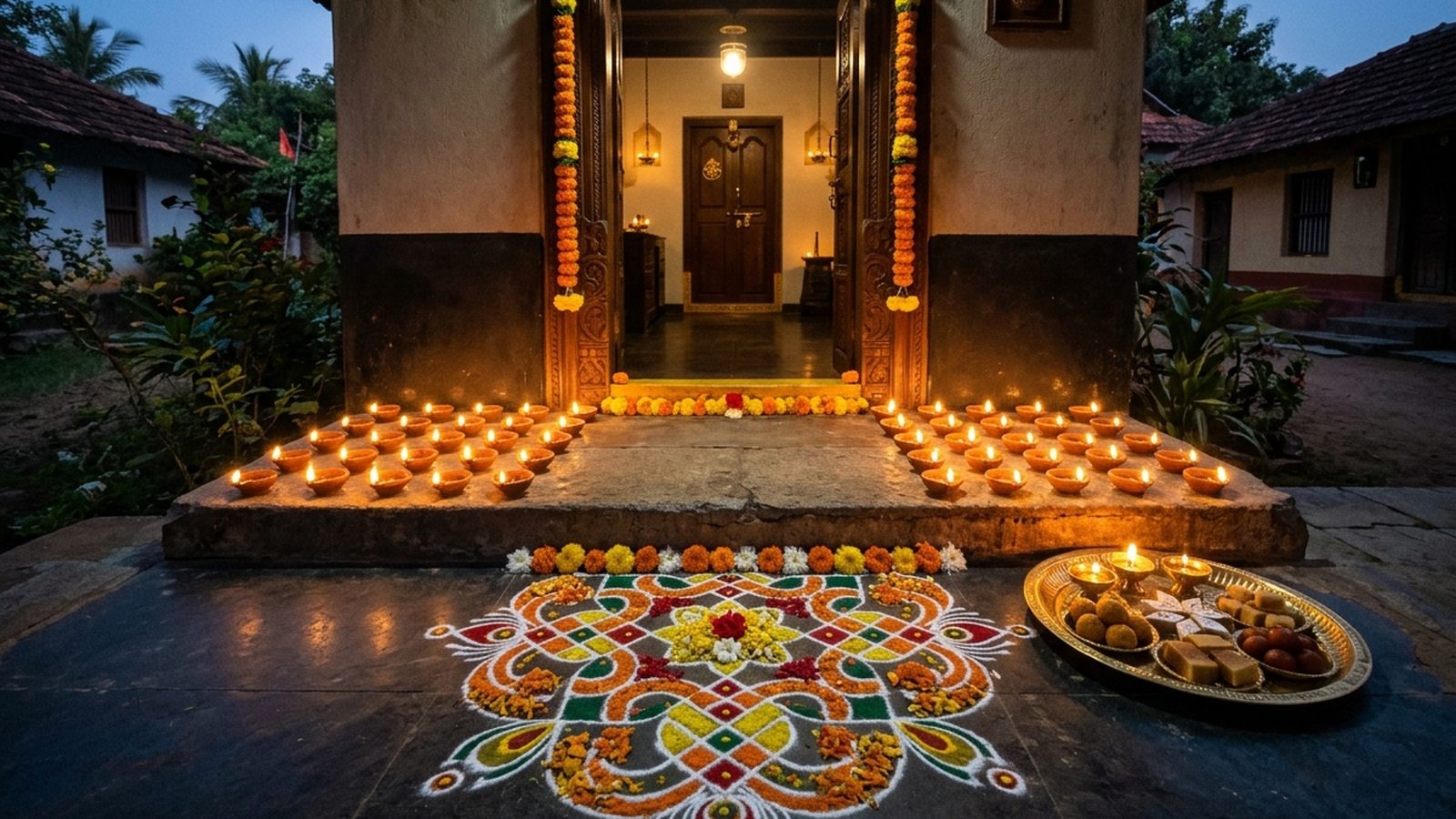
Deepavali (Diwali) is the supreme festival of illumination, triumph of dharma over adharma, and wealth consciousness. In South India, the primary celebration centers on Naraka Chaturdashi dawn with the sacred sesame oil bath (Ganga Snanam) before sunrise. In North and Western India, the pinnacle occurs on Amavasya evening during the Pradosha and Nishita muhurthams with Lakshmi-Ganesha Puja and rows of earthen lamps (diyas).
City Timings
Astronomical Geometry & The Double Nirnaya Rule
Deepavali calculations involve two distinct canonical Nirnaya moments that govern different cultural traditions: 1) Arunodaya Vyapti for Naraka Chaturdashi Snanam (South Indian tradition), and 2) Pradosha Vyapti on Amavasya for Lakshmi Puja (North, West, and Merchant traditions).
Arunodaya is astronomically defined as the period of 4 Ghatikas (approx. 96 minutes) prior to local sunrise. If Chaturdashi tithi prevails during Arunodaya, that morning is prescribed for Ganga Snanam. Meanwhile, Lakshmi Puja traditionally requires Amavasya tithi to prevail during Pradosha Kala (the evening after sunset, classically up to about 2 hours 24 minutes). Because Amavasya tithi frequently begins on one afternoon and ends on the next, timezone differences between India and the diaspora (e.g., Dallas, London, Sydney) can create a 1-day shift in when Pradosha meets Amavasya.
The Deepavali date shown on this page is the Tamil (South Indian) Deepavali, as Nava Panchangam's shipped rule computes it: the day, in the solar month Aippasi, on which Krishna Chaturdashi is current at sunrise. The Ganga Snanam window is the arunodaya before that sunrise. The evening window shown is the 90 minutes from sunset on that same day; the North Indian Amavasya Lakshmi Puja can fall on the following evening, and this page does not date it.
Luni-Solar Calendar Bridge: Ashvina vs. Kartika Amavasya Alignment
Ashvina Krishna Amavasya (South & Western India)
Kartika Krishna Amavasya (North India)
In North India's Purnimanta calendar, the month transitions on the Full Moon, meaning the dark fortnight begins Kartika. In South and Western India's Amanta calendar, the month ends on the New Moon, meaning this dark fortnight is the end of Ashvina. Both calendars name the same Amavasya, when Sun and Moon conjunct in Libra (Thula Rasi). South India keeps Deepavali on the Chaturdashi morning before it; North India on the Amavasya evening — which can be a different civil day, and can differ again from city to city.
Geodetic Vedic Sankalpam & Spatial Alignment
📍 Geodetic Vedic Sankalpam Studio
🌌 Traditional place clause: Jambu Dvīpe, Bhārata Varshe, Bhārata Khaṇḍe, Meroḥ Dakṣiṇa DigbhāgeRecite at the beginning of puja to orient your prayer in cosmic spacetime (Kāla-Deśa-Pātra):
Sacred Samagri & Interactive Shopping Checklist
Check off gathered items (saved automatically to your browser) or share the remaining list with your family via WhatsApp.
🪔 Puja Mandir & Deepam Essentials
🌸 Fresh Market & Botanical Offerings
🍯 Deepavali Marundhu & Sweet Groceries
👘 Sacred Snanam & New Clothes
Step-by-Step Puja Vidhi & Aradhana Procedure
🪔 Sacred Procedure
- Step 1 (Pre-Dawn Ganga Snanam): Wake up during Arunodaya (approx 4:30 AM local). Warm the infused sesame oil.
- Step 2: The mother or elder in the house applies the sanctified warm sesame oil to the crowns of family members with a coin blessing.
- Step 3: Bathe with warm water, reciting 'Gange Cha Yamune Chaiva Godavari Saraswati...' visualizing Ganga waters purifying all karma.
- Step 4: Wear new blessed clothes (Pudhu Aadaigal), consume a small marble-sized portion of Deepavali Lehyam for digestive wellness.
- Step 5: Light oil lamps at the altar, offer sweets to deities, seek blessings from family elders, and distribute festive platters to neighbors.
- Step 6 (Evening Lakshmi Puja): In the evening during the city's Pradosha window, set up the Lakshmi-Ganesha altar, light rows of clay diyas, recite Sri Suktam / Kanakadhara Stotram, and perform Maha Aarti.
Authentic Naivedyam Prasadam Recipes
Traditional proportions, temple-style techniques, and time-honored omens passed down through generations.
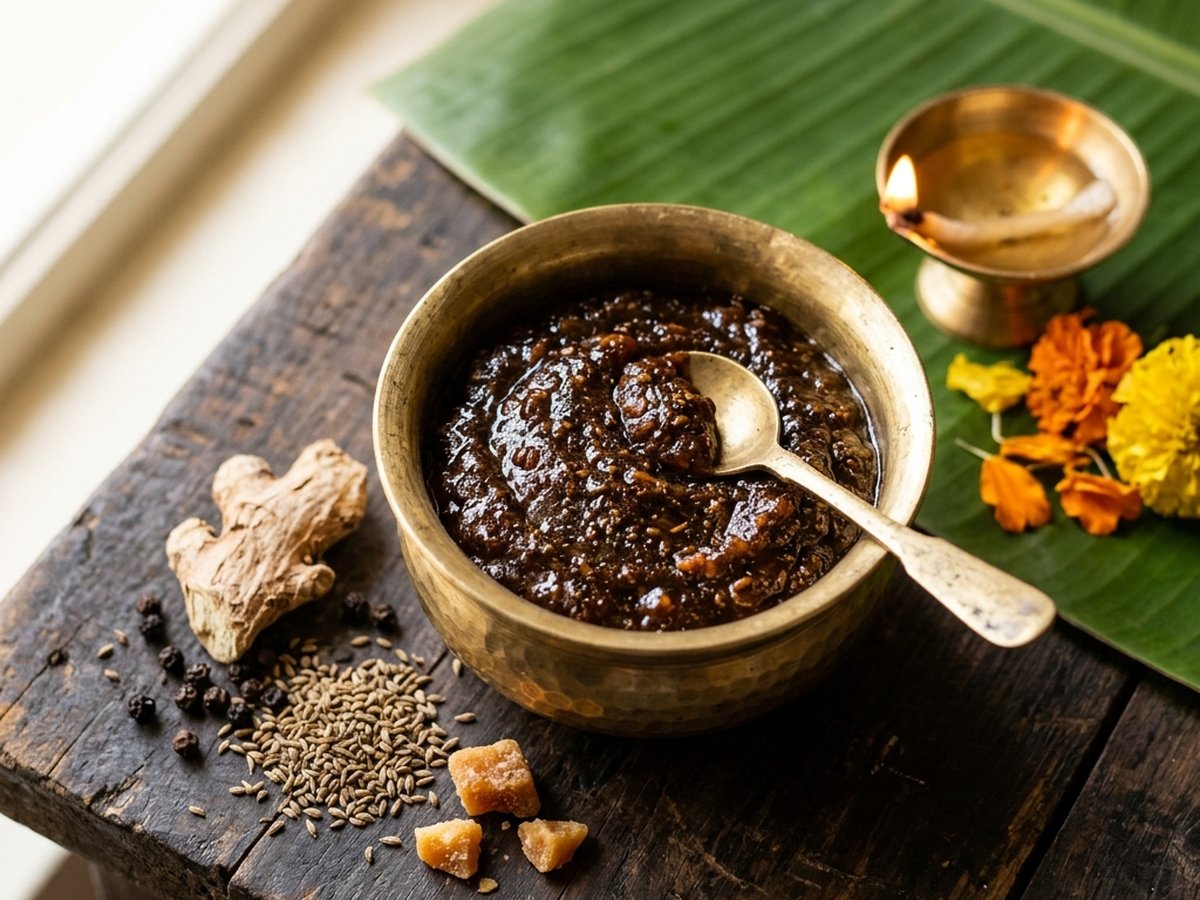
🍯 Traditional Deepavali Marundhu / Legiyam (Ayurvedic Digestive Elixir)
⚖️ Spices (Sukku + Milagu + Thippili + Omam + Dhaniya) 140g : Jaggery 300g : Ghee 50g : Honey 50g⏱️ Prep 15 min · Cook 30 min
Ingredients & Proportions:
- 50g dry ginger (Sukku - peeled and crushed)
- 20g black peppercorns (Milagu)
- 20g long pepper (Thippili)
- 25g carom seeds (Omam / Ajwain)
- 25g whole coriander seeds (Dhaniya)
- 300g organic jaggery
- 4 tbsp pure cow ghee
- 3 tbsp raw honey
- 1 cup water
Method & Procedure:
- Dry roast sukku, milagu, thippili, omam, and coriander seeds individually on low flame until fragrant. Cool and grind to a very fine powder.
- Dissolve jaggery in 1 cup water, heat until dissolved, and strain to remove dust and grit.
- Return jaggery water to heavy-bottom pan and simmer until it reaches a single-string syrup consistency.
- Lower heat to minimum. Gradually whisk in the ground spice powder, stirring continuously to prevent any lumps from forming.
- Cook on medium-low flame, adding cow ghee one tablespoon at a time. The mixture will thicken and begin rolling off the pan sides without sticking (halwa consistency).
- Remove from stove. Let cool to lukewarm temperature before folding in raw honey (heating honey destroys therapeutic enzymes). Store in a glass jar.
Health Secret: Consumed as a small betel-nut sized marble on an empty stomach immediately after the dawn Ganga Snanam. Ignites the digestive fire (Jatharagni), neutralizing the richness of festival sweets and savories throughout the day.
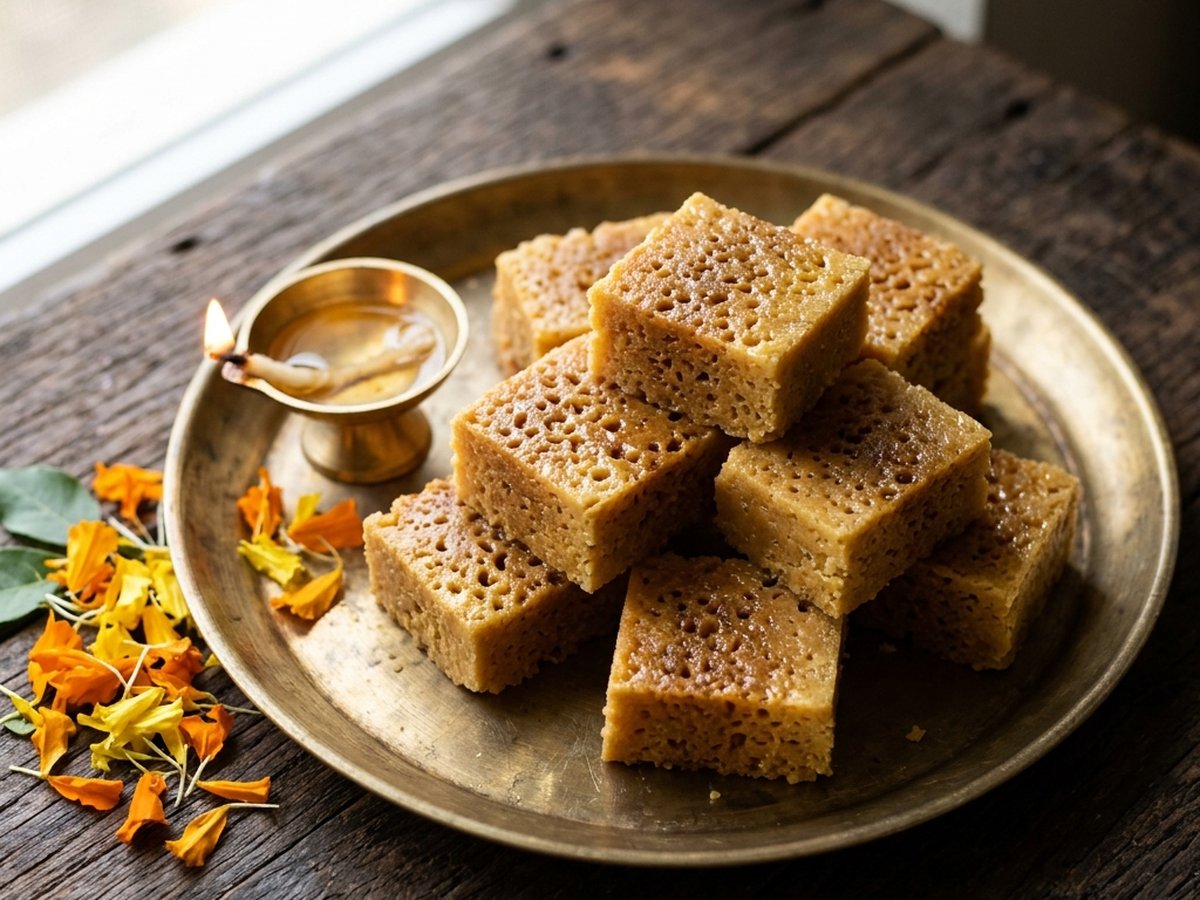
🍯 Traditional Ghee Mysore Pak (Porous & Melt-in-Mouth)
⚖️ Besan (Gram Flour) : Sugar : Pure Ghee = 1 : 2 : 2⏱️ Prep 10 min · Cook 25 min
Ingredients & Proportions:
- 1 cup fine gram flour (Besan / Kadalai Maavu)
- 2 cups granulated white sugar
- 2 cups pure cow ghee
- 1/2 cup water
Method & Procedure:
- Sift gram flour twice to eliminate all tiny lumps. Dry roast on very low flame for 2 minutes just until the raw aroma vanishes.
- In a separate saucepan, melt all 2 cups of ghee and keep it simmering on very low flame throughout the cooking process (the ghee must be hot when added!).
- In a wide heavy kadai, combine sugar and water. Boil to reach a 1-string consistency (when syrup dropped between thumb and index finger forms a continuous thread).
- Lower flame and sprinkle roasted besan gradually with one hand while whisking vigorously with the other to avoid lumps.
- Once smooth, begin pouring ladlefuls of hot simmering ghee into the mixture. Stir continuously. The besan absorbs the ghee and froths with honeycomb air bubbles.
- When the mixture becomes porous, floats on bubbles, and releases ghee around the edges, immediately pour into a pre-greased rectangular tin. Do NOT press or smoothen the top (pressing destroys the porous honeycomb structure).
- After 10 minutes, slice into squares while still warm.
Culinary Key: Pouring boiling hot ghee into the simmering besan is what creates the porous honeycomb tunnels. If the ghee is cold, the Mysore Pak will turn dense and fudge-like.
Sacred Threshold Art Blueprint: Kolam & Rangoli
📐 Kubera Yantra Magic Square & Ashta Lakshmi Vilakku Kolam
📐 Grid Pattern / Dot Matrix: 3x3 Magic Square grid (every row, column and diagonal totals 72) encircled by 8-petal Lotus and 8 oil lampsDrawing Sequence:
- Purify the home entrance threshold or puja mandir floor with water and turmeric.
- Construct a 3x3 square grid in red kaavi or yellow turmeric lines.
- Inscribe the sacred Kubera Yantra numbers using rice flour paste: Top row (27, 20, 25), Middle row (22, 24, 26), Bottom row (23, 28, 21). Each row, column and diagonal adds to 72.
- Draw eight lotus petals extending outward from the square borders.
- Place eight illuminated brass or clay deepams filled with sesame oil on each petal.
- Border the perimeter with unbroken lines of authentic red kaavi.
Tradition associates the number 72 of the Kubera Yantra with wealth retention and freedom from debt (Rina Vimochana). The 8 surrounding lamps invite the eight forms of Ashta Lakshmi into the abode.
Sacred Snanam & Pitru Tharpanam Protocol
🌊 Brahma Muhurtha Ganga Snanam & Naraka Chaturdashi / Amavasya Pitru Tharpanam Sequencing
- 1. Arunodaya Oil Application (04:00 AM - 05:30 AM): Elder woman of the house applies warm sesame oil mixed with peppercorn to the crown of every family member with blessings.
- 2. Sacred Ganga Snanam: Bathe in hot water before sunrise chanting 'Gange cha Yamune chaiva Godavari Saraswati Narmade Sindhu Kaveri jalesmin sannidhim kuru'. All hot water is revered as Ganga water at this auspicious moment.
- 3. New Clothes & Deepavali Marundhu: Don new clothes and immediately consume a marble-sized portion of Deepavali Marundhu.
- 4. Devata Aradhana: Light lamps in the puja room, offer sweets to Sri Lakshmi Narayana, and celebrate with family.
- 5. Aparahna Pitru Tharpanam (Crucial Shastric Rule): For those with the duty of Tharpanam, Deepavali Amavasya Pitru Tharpanam is performed during Aparahna (the fourth fifth of daylight, roughly 1:15-3:45 PM on a 12-hour day), NOT during the dawn Ganga Snanam window. Darbha grass and black sesame seeds are used.
Classical Shastras declare: 'Thailam Lakshmi Jale Ganga Deepavali dine smrutha' — Goddess Mahalakshmi resides in sesame oil and holy river Ganga resides in all water during Naraka Chaturdashi Arunodaya. Ancestral tharpanam belongs to the Amavasya afternoon (aparahna) window, keeping the auspicious Deva celebration at dawn apart from the Pitru kriya in the afternoon.
Purity & Ritual Guidelines
- Arunodaya oil bath is mandatory on Naraka Chaturdashi; Shastras state that Goddess Lakshmi resides in sesame oil and Mother Ganga in warm water on this morning.
- Avoid daytime sleeping on Deepavali day; maintain a joyful, sattvic atmosphere free from quarrel.
- Clean and sweep the home thoroughly before the evening Lakshmi Puja so Alakshmi (inauspiciousness) departs.
- Bursting fireworks (if permitted locally) should be conducted responsibly with cotton clothing and ear protection.
Following the early morning bath and prayers, family members partake in traditional Deepavali sweets (Adhirasam, Murukku) alongside festive meals. Those observing the full Lakshmi Vratam fast until the conclusion of the evening Pradosha puja.
The 5 Days of the Diwali Festival Cycle
Day 1: Dhanteras (Dhanatrayodashi & Yama Deepam)
Ashwin/Kartika Krishna Trayodashi. Worship of Lord Dhanvantari (deity of health) and Lord Kubera. Purchase of metals, gold, and lighting a four-wick lamp facing south for Yama.
- Buying gold, silver, or kitchen utensils
- Dhanvantari Puja for radiant health
- Yama Deepam at entrance facing south
Day 2: Naraka Chaturdashi (Choti Diwali / Ganga Snanam)
The day Lord Krishna and Satyabhama vanquished the tyrant demon Narakasura. Celebrated with the sacred dawn oil bath.
- Pre-dawn sesame oil bath (Ganga Snanam)
- Wearing new clothes
- Lighting dawn lamps
Day 3: Lakshmi Puja & Deepavali Amavasya
The supreme Night of Illumination. Goddess Mahalakshmi visits homes illuminated by oil lamps, bestowing spiritual and material prosperity.
- Pradosha Lakshmi-Kubera Puja
- Bahi Khata (Account Books) worship for merchants
- Lighting countless clay diyas across balconies and thresholds
Day 4: Govardhan Puja & Annakut (Bali Pratipada)
Kartika Shukla Pratipada. Commemorates Krishna lifting Govardhan Hill. Devotees prepare a mountain of vegetarian delicacies (Annakut).
- Govardhan hill modeling from cow dung/sweets
- Annakut 56-bhog offering
- King Bali worship
Day 5: Bhai Dooj / Yama Dwitiya
Kartika Shukla Dwitiya. Celebrating the bond between brothers and sisters. Sisters apply tilak to brothers' foreheads praying for their long life.
- Sister applies vermilion tilak to brother
- Brother offers gifts of appreciation
- Special festive family lunch
Pan-Indian Traditions & Cultural Nuances
📍 Tamil Nadu & South India
Deepavali Ganga Snanam
Pre-dawn sesame oil bath, Deepavali Marundhu (lehyam), and asking each other 'Ganga Snanam Aacha?'.
📍 North India (UP, Delhi, Punjab)
Diwali & Lakshmi Puja
Evening Lakshmi-Ganesha puja, exchange of dry fruits and mithai, lighting diyas in rangolis.
📍 West Bengal & Eastern India
Kali Puja & Shyama Puja
Midnight worship of Goddess Kali at cremation grounds and pandals on Amavasya night.
📍 Gujarat & Maharashtra
Diwali & Bestu Varas
Chopda Pujan (new accounting ledger sanctification) and celebrating the Gujarati New Year (Bestu Varas) the following day.
📍 Jain Community
Mahavira Nirvana
Commemorating Bhagwan Mahavira's liberation (Moksha) at Pavapuri by lighting lamps of enlightenment.
Diaspora Living Guide: Celebrating Deepavali Safely Overseas
- Apartment Diya Placement: Place clay lamps on ceramic plates or fire-resistant metal trays away from curtains, tapestries, or flammable decor. Use flameless LED tea lights in hallways if building bylaws prohibit open flames.
- Smoke Alarms & Dhoop: Avoid burning heavy incense or charcoal sambrani indoors. Opt for mild camphor or diffused essential oils.
- Fireworks Compliance: Never light firecrackers on apartment balconies or unauthorized community grounds in the US, UK, or Australia. Participate in temple or city-organized public fireworks displays.
- Weekday Time Management: When Deepavali falls on a Monday–Thursday working day, complete the dawn Ganga Snanam and oil bath before heading to office, reserving the grand feast and evening diya lighting for sunset.
Modern Apartment Living & Emergency Substitutions
Regional Distinction — South India vs North India: In Tamil Nadu, Karnataka, Andhra Pradesh, and Kerala, the primary celebration is Naraka Chaturdashi dawn (commemorating Krishna and Satyabhama vanquishing the demon Narakasura). In North India, Maharashtra, and Gujarat, the main festival is celebrated on Amavasya evening with Grand Pradosha Lakshmi-Kubera Puja and Chopda Pujan (commemorating Sri Rama's triumphant return to Ayodhya).
🏢 Apartment-Safe Hacks & Diaspora Solutions
- Missing Deepavali Lehyam Herbs? Mix dry ginger powder (Sukku), black pepper powder, honey, and ghee into a smooth paste as an effective instant Ayurvedic substitute.
- Apartment HOA Firecracker Ban? Illuminate balcony with battery LED fairy lights, flameless clay diyas, and celebrate with indoor paper poppers or community courtyard sparklers.
- Clay Diyas Oil Staining Countertops? Place small ceramic tiles or coin-sized silicone pads under each clay lamp to prevent hot oil seepage.
- No Darbha Grass for Tharpanam? Shastras permit using unbroken raw rice mixed with sesame seeds with mental visualization of Darbha.
Spiritual Significance & The Inner Victory Over Darkness
Beyond historical legends, Deepavali carries a universal psychological and spiritual truth: the eternal battle between inner ignorance (Avidya) and spiritual illumination (Jnana). Narakasura represents the lower egoistic instincts — pride, greed, and possessiveness — that imprison the pure qualities of consciousness (the 16,000 captive maidens in the Purana). When Sri Krishna and Satyabhama vanquish Narakasura, consciousness is liberated from bondage.
Every single lamp lit during Deepavali represents a spark of awareness. A single diya can ignite hundreds of others without losing its own radiance. Similarly, spiritual wisdom shared with family and community enriches all without diminishing the source.
Frequently Asked Questions About Deepavali
Why is Ganga Snanam performed early in the morning before sunrise? ▾
According to tradition, Naraka Chaturdashi occurs during the Arunodaya period (96 minutes before sunrise). Shastras grant a boon that on this specific dawn, Goddess Lakshmi resides in sesame oil and the sacred River Ganga manifests in all water, purifying the bather of bad karma and sins.
What is the difference between Choti Diwali and Badi Diwali? ▾
Choti Diwali is Naraka Chaturdashi (Day 2 of the 5-day festival), focused on the destruction of Narakasura and dawn cleansing. Badi Diwali is the main Amavasya day (Day 3), featuring grand evening Lakshmi Puja and widespread illumination.
Why does Lakshmi Puja timing differ between Dallas and Mumbai? ▾
Lakshmi Puja requires Amavasya tithi to prevail during the local evening Pradosha Kala. Because Dallas is 10.5 to 11.5 hours behind India, the astronomical instant when Amavasya starts or ends can align with Pradosha on a different civil calendar date in Dallas compared to Mumbai.
See Your City's Panchangam for the Day
This page shows the Deepavali date and Ganga Snanam window for each city it lists. For any other day: tithi, nakshatra, sunrise, sunset and Rahu Kalam for your city.
Open Your City's Panchangam →