
Thai Pongal & Makara Sankranti 2027: Date, Muhurtham & Solar Ingress Guide in Mumbai
The definitive guide to Makara Sankranti solar transition, auspicious cooking timings, 4-day ritual sequence, and global diaspora celebrations.
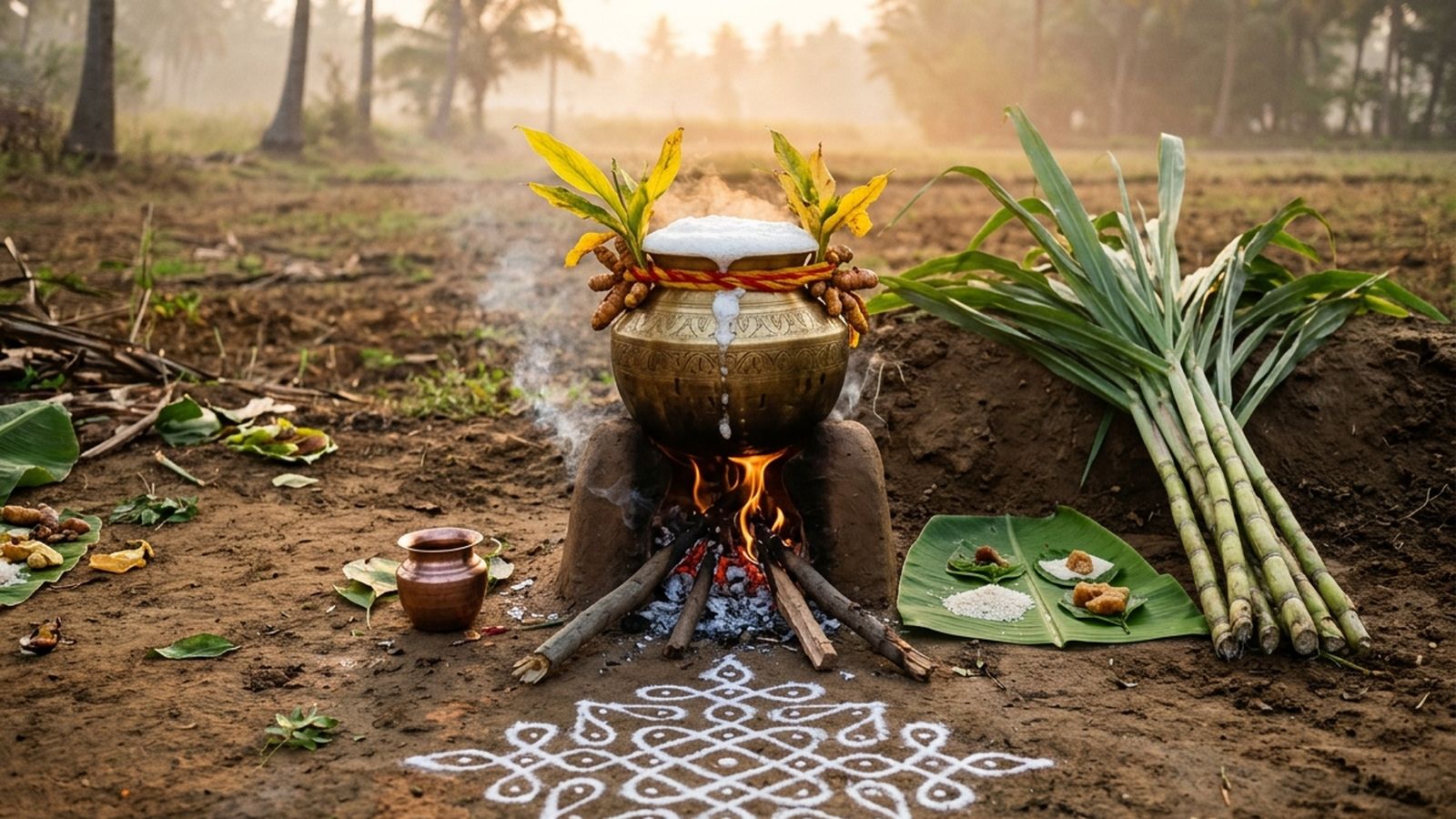
Thai Pongal marks the solar ingress (Makara Sankranti) when the Sun moves into sidereal Capricorn (Makara Rasi), commencing the sacred Uttarayana northward transit. Celebrated on the 1st day of the Tamil solar month Thai (January 14–15), families boil sweet freshly harvested rice with milk in brass or earthen pots facing the morning Sun, rejoicing with 'Pongalo Pongal!' to welcome abundance, agricultural fertility, and cosmic harmony.
City Timings
Astronomical Geometry & The Classical Nirnaya Rule
Unlike lunar festivals that track the Moon's phase (Tithi), Thai Pongal is strictly solar (Sauramana). It begins when the Sun, reckoned sidereally, reaches 270° and passes from Dhanu (Sagittarius) into Makara (Capricorn).
The classical Nirnaya rule for Sauramana month ingress establishes: if the solar ingress (Sankramana) occurs between local sunrise and sunset, that civil day is designated as Thai 1. If the ingress occurs after sunset, the festival and month-start shift to the following morning. Because of global timezones, when the transit occurs during nighttime in India, it may occur during daytime in North America (Dallas, Chicago, New York), occasionally placing Thai Pongal on different civil calendar dates. This page shows the day on which Nava Panchangam's engine places Thai 1 for each city; it does not print the transit instant itself.
In traditional Jyotisha, this moment initiates Uttarayana — the Sun's apparent northern trajectory along the ecliptic, symbolizing enlightenment, awakening, and the day of the Devas.
Solar vs. Luni-Solar Calendar Alignment: Sauramana Thai 1 & Makar Sankranti
Poush / Magha Amanta (Solar transit into Makara Rasi)
Magha Krishna Paksha (Solar transit into Makara Rasi)
Unlike purely lunar festivals, Makara Sankranti is governed by the Sun's exact sidereal entry (Sankramana) into Capricorn (Makara Rasi). In Tamil Nadu, this solar day marks the 1st of the solar month 'Thai' (Sauramana system). In North India, it falls during the lunar month of Magha. Because it is tied to the Sun rather than Moon phases, both traditions mark the same solar event. The civil day can still differ — between cities (the transit can fall in Chennai's night and Dallas's day) and between regional rules for when a solar month begins.
Geodetic Vedic Sankalpam & Spatial Alignment
📍 Geodetic Vedic Sankalpam Studio
🌌 Traditional place clause: Jambu Dvīpe, Bhārata Varshe, Bhārata Khaṇḍe, Meroḥ Dakṣiṇa DigbhāgeRecite at the beginning of puja to orient your prayer in cosmic spacetime (Kāla-Deśa-Pātra):
Sacred Samagri & Interactive Shopping Checklist
Check off gathered items (saved automatically to your browser) or share the remaining list with your family via WhatsApp.
🪔 Puja Mandir Shelf Essentials
🌿 Fresh Market & Farm Produce
🍚 Grocery & Naivedyam Pantry
🎨 Altar & Kolam Threshold Decor
Step-by-Step Puja Vidhi & Aradhana Procedure
🪔 Sacred Procedure
- Step 1: Clean and decorate the courtyard or balcony facing east. Draw an auspicious Kolam (rangoli) with wet rice flour.
- Step 2: Tie the fresh turmeric plant with yellow thread around the neck of the cleaned pot. Apply sandalwood and vermilion dots.
- Step 3: Pour whole milk and clean water into the pot and place it over the stove or earthen hearth during the auspicious Subha Horai window.
- Step 4: As the milk heats and foams to the rim, watch it boil over facing east or north. Everyone chants 'Pongalo Pongal!' with claps and Conch sounds.
- Step 5: Rinse the new raw rice with a few drops of milk and gently pour it into the boiling pot clockwise.
- Step 6: Cook until soft, stir in grated jaggery and ghee-roasted cashews and raisins. Finish with crushed cardamom and a pinch of edible camphor.
- Step 7: Serve the sweet pongal on a fresh banana leaf facing the morning Sun, offering arghya (water offering), flowers, and lighting camphor aarti.
Authentic Naivedyam Prasadam Recipes
Traditional proportions, temple-style techniques, and time-honored omens passed down through generations.
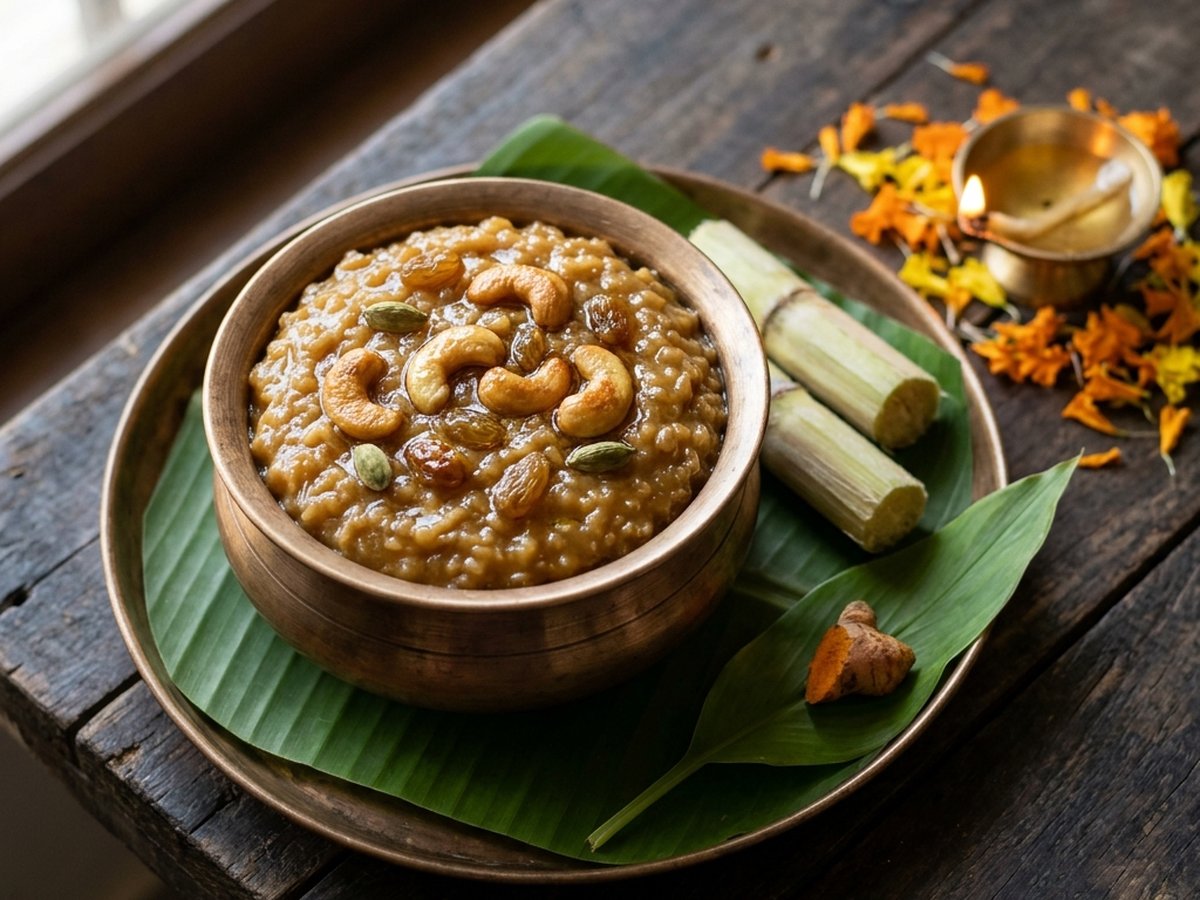
🍯 Traditional Sakkarai Pongal (Vengala Paanai Method)
⚖️ Raw Rice : Moong Dal : Jaggery : Ghee = 1 : 0.25 : 2 : 0.5 (with 4 cups liquid: 3 water + 1 milk)⏱️ Prep 10 min · Cook 45 min
Ingredients & Proportions:
- 1 cup new harvest raw rice (washed and drained)
- 1/4 cup yellow split moong dal
- 2 cups dark grated organic jaggery
- 1/2 cup pure melted cow ghee
- 15 whole cashews & 15 golden raisins
- 1/2 tsp freshly ground cardamom powder
- 1 tiny speck (pinhead size) edible camphor (Pachai Karpooram)
- 1 cup fresh whole cow milk + 3 cups pure water
Method & Procedure:
- Dry roast yellow moong dal in a pan on medium-low flame for 2-3 minutes until lightly fragrant and golden (do not brown). Wash together with raw rice.
- In the traditional brass or clay pot, pour the milk and water. Bring to a rolling boil over medium-high heat. When the milk froths and overflows the rim, chant 'Pongalo Pongal!' facing the eastern sky.
- Immediately lower heat to medium and add the drained rice-dal mixture. Simmer uncovered, stirring occasionally with a long ladle so the bottom does not scorch, until the rice and dal are completely tender, soft, and mashable.
- In a separate small saucepan, dissolve grated jaggery in 1/2 cup water over low heat. Once melted, strain through a fine tea strainer to eliminate grit, sand, and impurities.
- Pour the warm strained jaggery syrup into the thoroughly cooked soft rice. CRITICAL: Rice grains will cease softening once jaggery is added, so guarantee total tenderness before this step! Stir gently on low heat for 4-5 minutes until jaggery integrates smoothly.
- In a small tempering ladle, heat 3 tbsp of ghee. Fry split cashews until golden, add raisins until they puff like balloons, and immediately pour over the pongal.
- Stir in remaining ghee, crushed cardamom, and the microscopic speck of crushed edible camphor. Cover with lid and rest 5 minutes before offering as Surya Naivedyam.
Boiling Foam Direction Omen: Shastras hold that if the milk foam spills toward the East or Northeast (Eshanya), it portends extraordinary spiritual illumination, health, and agricultural abundance. Spilling toward the North foretells wealth and business prosperity. Culinary Secret: Always roast moong dal slightly before boiling to prevent slimy texture. Never add jaggery until the rice grain crushes smoothly between thumb and finger without any chalky core.
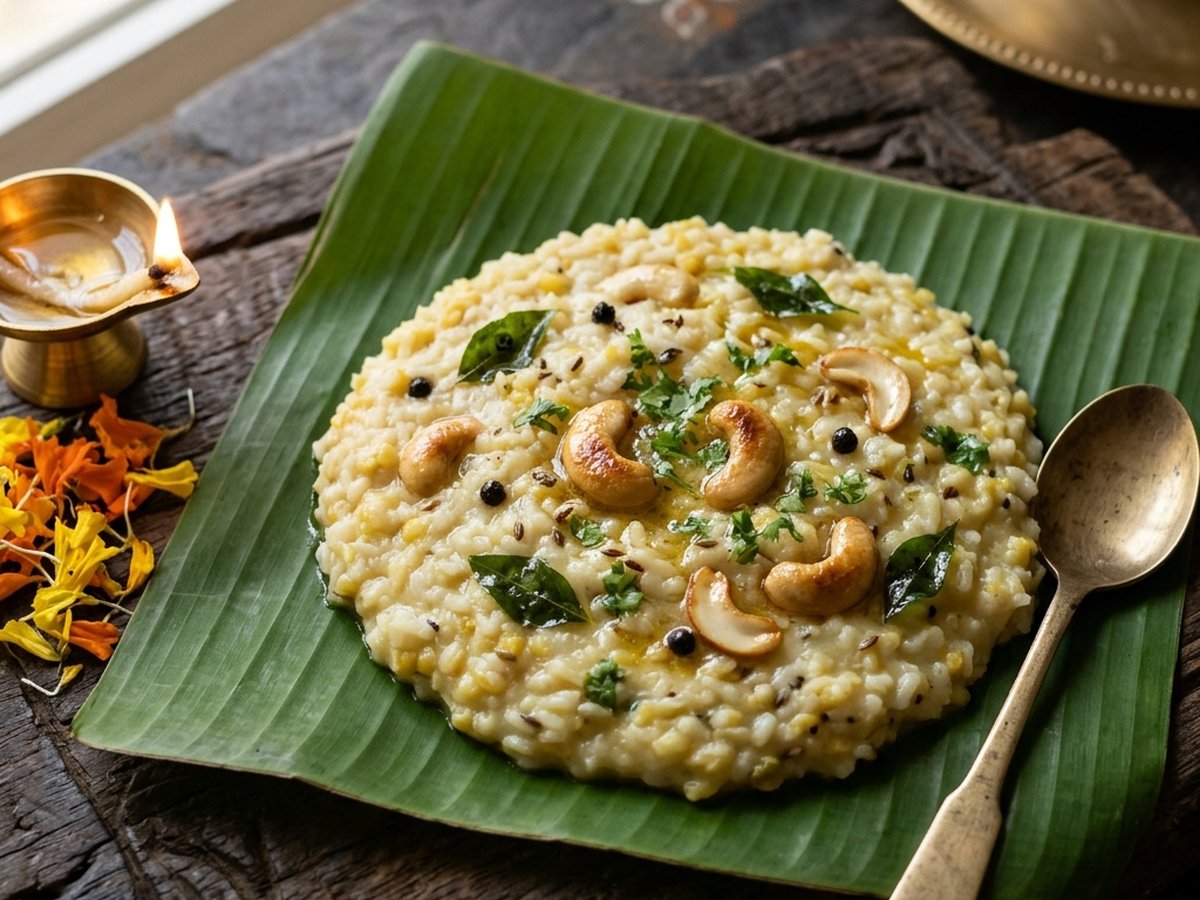
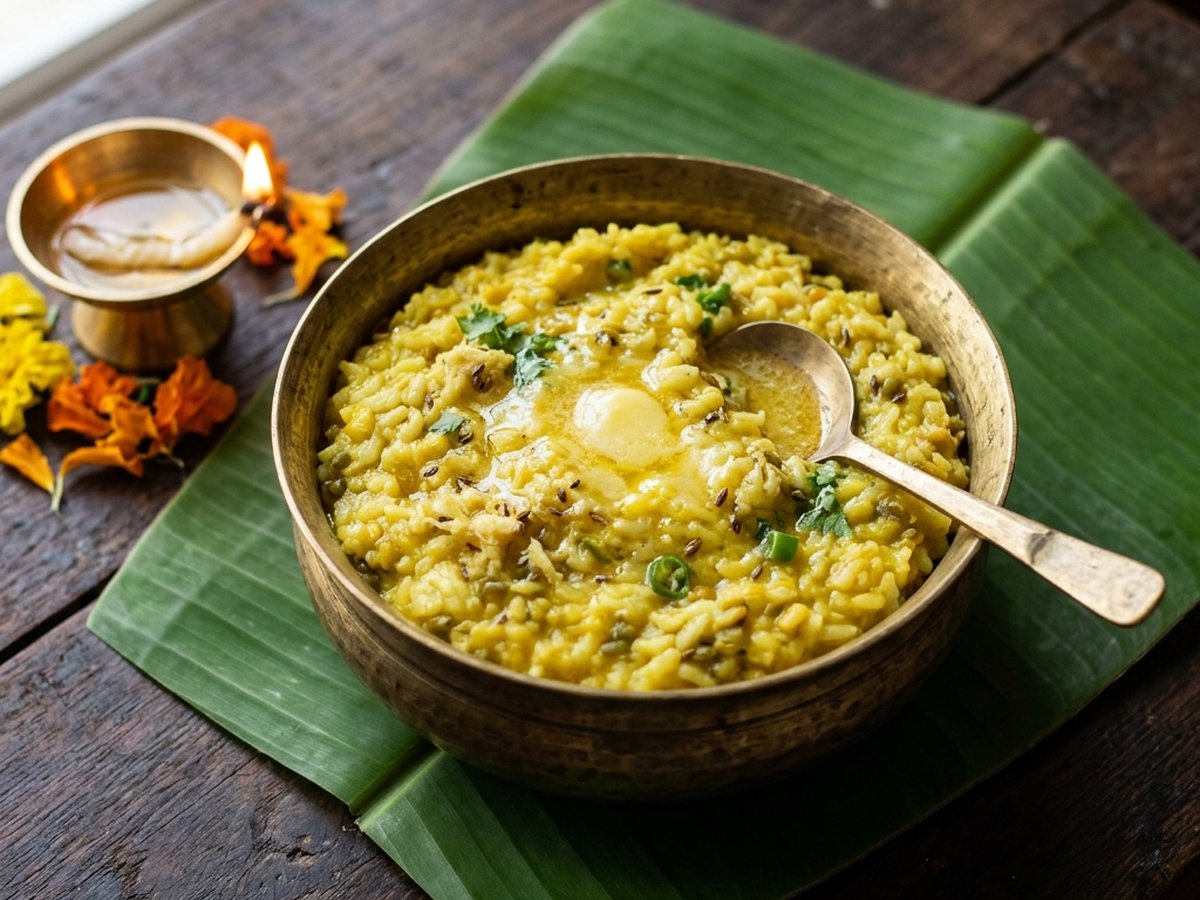
🍯 Temple-Style Kovil Ven Pongal
⚖️ Raw Rice : Moong Dal : Water = 1 : 0.5 : 4.5 (Rich ghee tempering)⏱️ Prep 10 min · Cook 30 min
Ingredients & Proportions:
- 1 cup raw rice & 1/2 cup yellow split moong dal
- 4.5 cups water + 1/2 cup milk
- 1 tsp coarse cracked black pepper & 1 tsp whole cumin seeds (Jeera)
- 1 tbsp finely minced fresh ginger
- 2 sprigs fresh curry leaves
- 1 pinch pure asafoetida (Hing)
- 1/4 cup pure cow ghee & 15 fried cashews
- 1 tsp rock salt (to taste)
Method & Procedure:
- Dry roast moong dal until lightly golden and aromatic. Combine with raw rice and rinse thoroughly.
- Pressure cook (or pot-cook) rice and dal with 4.5 cups water, 1/2 cup milk, and salt for 4-5 whistles until super soft and porridge-like.
- Mash gently while steaming hot using the back of a ladle.
- Heat ghee in a pan; add cumin seeds, coarsely cracked peppercorns, minced ginger, curry leaves, and cashews. Add hing at the very end.
- Pour bubbling spiced ghee over the mashed pongal. Fold in gently until glossy and aromatic.
Temple Secret: Adding 1/2 cup of milk during boiling gives the pongal its signature silky melting texture. Coarsely crack the peppercorns rather than powdering them to release essential oils without darkening the golden-white hue.
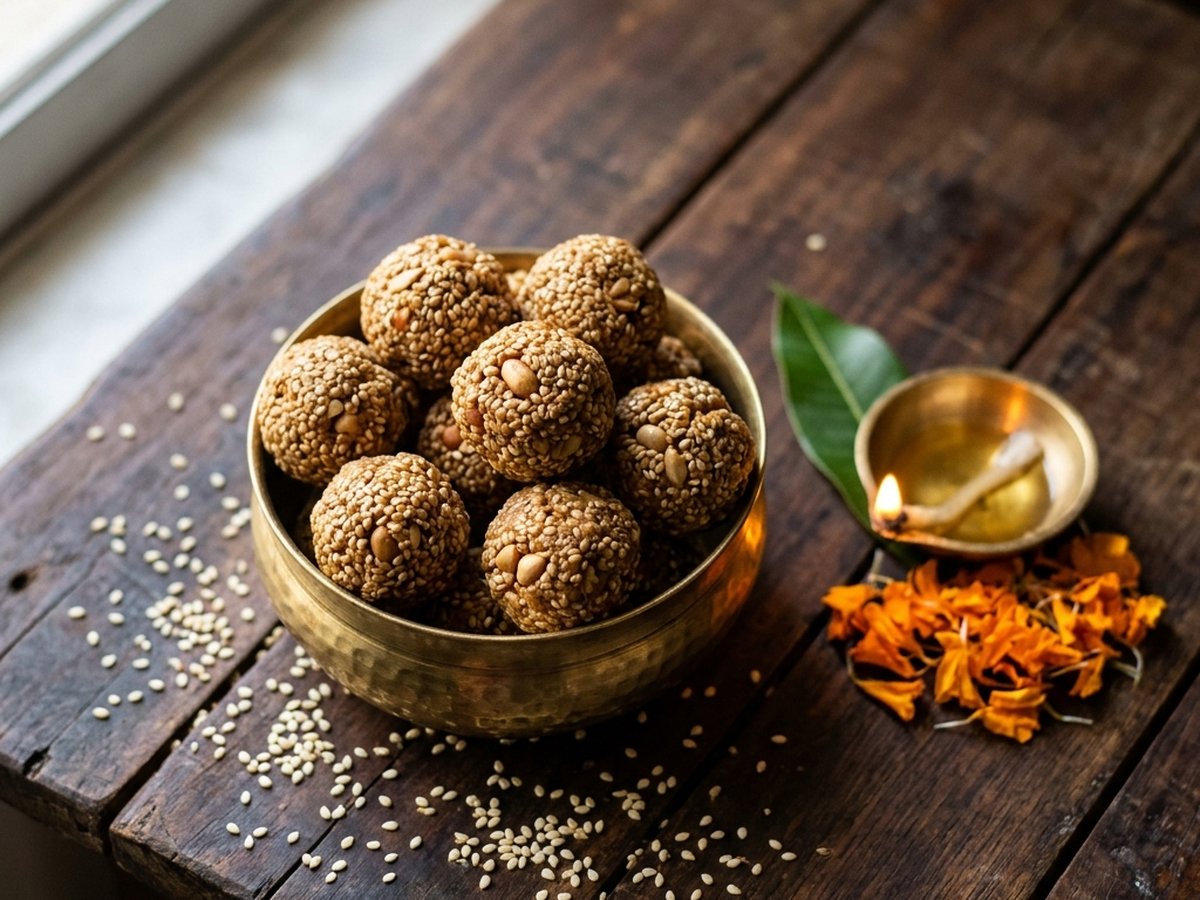
Sacred Threshold Art Blueprint: Kolam & Rangoli
📐 Sankranti Paanai & Surya Padam Kolam
📐 Grid Pattern / Dot Matrix: 7 to 4 straight dots (Ner Pulli) or 9 to 5 interleaved dots (Idukku Pulli)Drawing Sequence:
- Thoroughly sweep the entrance threshold and sprinkle water mixed with cow dung or turmeric water for purifying the threshold (Shuddhi).
- Lay out the central dot grid: start with 7 dots in the center, tapering down by one dot on each side to 4 dots.
- Sketch the central boiling pot (Paanai) with curved overflowing milk lines radiating upward and eastward.
- Flank both sides with symmetrical tall sugarcane stalks (Karumbu) with jointed nodes and leafy tops.
- Draw radiating sunbeams (Surya Kiranams) around the top of the pot to represent the dawn solar ingress.
- Trace an outer protective border with natural red kaavi (iron oxide geru paste) to seal the threshold.
Traditional rice flour kolam serves as Bhuta Yajna — feeding thousands of ants and micro-creatures as the first charity of dawn. The red Kaavi border represents the earth element (Bhu Devi) and acts as a psychic seal to keep disruptive frequencies outside the threshold.
Sacred Snanam & Pitru Tharpanam Protocol
🌊 Makara Sankranti Snanam & Pitru Tharpanam Sequence
- 1. Dawn Thila Snanam: Bathe early in the morning before sunrise using water infused with sesame seeds, chanting the sacred snanam sloka.
- 2. Surya Arghya: Face the rising Sun and offer pure water mixed with red flowers and akshata three times using the palms joined together.
- 3. Pongal Cooking & Puja: Boil the sweet Pongal at the appointed Subha Horai window and complete the family aradhana with Karpura Arati.
- 4. Aparahna Pitru Tharpanam (Crucial Timing): Perform Makara Sankranti Pitru Tharpanam during Aparahna (the fourth fifth of daylight, roughly 1:15-3:45 PM on a 12-hour day) using black sesame seeds and Pavithram made of Darbha grass.
- 5. Prasad Grahanam: Consume the Pongal feast only after completing both Deva puja and Pitru tharpanam.
Apastamba & Bodhayana Dharma Sutras declare: 'Sankramane snana-dana-pitru-karmasu phalam anantam.' Makara Sankranti marks Uttarayana — the sunrise of the Gods and the transition moment for ancestral pitrus. Performing tharpanam during Aparahna satisfies three generations of ancestors, bestowing lineage longevity (Vamsha Vriddhi) and freedom from Pitru Dosha.
Observance Guidelines & Purity Rules
- Wake before sunrise during Brahma Muhurtham (approx 4:30–5:30 AM local).
- Take an auspicious oil bath or herbal bath before lighting the home altar.
- Strictly avoid boiling pongal during Rahu Kalam or Yamagandam; always honor the local Subha Horai.
- Maintain pure vegetarianism; avoid onion, garlic, or processed food during the sacred puja day.
- Distribute sweet pongal to neighbors, friends, and workers before family consumption.
Thai Pongal is a celebration of harvest rather than a waterless fast. Family members partake in the sanctified Sakkarai Pongal immediately following the Surya Aarti, accompanied by a traditional vegetarian festive lunch served on plantain leaves.
The 4 Sacred Days of the Pongal Festival
Day 1: Bhogi Pandigai (De-Cluttering & Renewal)
Celebrated on the last day of Margazhi month, dedicated to Lord Indra, deity of rains. Old domestic thatch is discarded, and mindsets are cleansed to welcome new prosperity.
- Cleaning the home and whitewashing walls
- Burning symbolic organic waste
- Prayers to Indra for plentiful rains
Day 2: Thai Pongal (Surya Aradhana & Boiling Ritual)
The primary day of Makara Sankranti. Families gather outdoors or in sunlit kitchens to boil sweet milk-rice facing east.
- Elaborate rice-flour Kolams at entrance
- Boiling sweet pongal in new pots
- Chanting 'Pongalo Pongal!' as milk overflows
- Surya Namaskar & Aarti
Day 3: Mattu Pongal & Kanu Pidi (Gratitude to Cattle & Brothers)
Honoring livestock that plow the fields. Women perform the Kanu Pidi ritual praying for the prosperity and longevity of their brothers.
- Bathing cows/bulls and decorating horns with vibrant paint
- Feeding cows sweet pongal and sugarcane
- Kanu Pidi: Placing colorful rice balls on turmeric leaves for birds
Day 4: Kaanum Pongal (Family Reunions & Nature Excursions)
The day of social harmony. Families visit relatives, seek elders' blessings, and enjoy community picnics near beaches or riverbanks.
- Seeking blessings from parents and elders
- Community fairs, folk arts, and beach visits
- Sharing festive variety rices (lemon, tamarind, curd rice)
Cross-Regional Names & Celebrations Across India
📍 Tamil Nadu & Diaspora
Thai Pongal
Boiling milk in earthen pots, sugarcane offerings, and Mattu Pongal cattle worship.
📍 Andhra Pradesh & Telangana
Pedda Panduga / Sankranti
3-day festival with Haridasu songs, Gobbemma cow-dung decorations, and kite flying.
📍 Karnataka
Makara Sankramana
Sharing 'Ellu Bella' (sesame, jaggery, dried coconut mix) with the message: 'Ellu bella thindu olle maathadi' (eat sesame-jaggery and speak sweet words).
📍 Punjab & Northern India
Lohri & Maghi
Community bonfire on the eve, offering popcorn, rewari, and groundnuts with Giddha and Bhangra dances.
📍 Gujarat & Western India
Uttarayan
Massive international kite flying festival, undhiyu delicacies, and sesame jalebis.
📍 Assam & Northeast
Magh Bihu / Bhogali Bihu
Feasting around thatched bamboo huts (Bhelaghar) and burning them the next morning.
Diaspora Living Guide: Celebrating in Apartments Overseas (Dallas, London, etc.)
- Electric & Induction Stoves: Use a clean stainless steel pot or dedicated brass vessel. Maintain medium heat so milk gently boils over without smoking or tripping apartment smoke alarms.
- Sun Altar Near Window: If you lack an open courtyard, position a small altar table by an east-facing window or balcony receiving morning natural light. Place a picture or small yantra of Surya Narayana.
- Substitute Sourcing: If fresh whole turmeric roots or stalks are difficult to locate at local Asian/Indian grocery stores in Texas or the UK, tie a pinch of turmeric powder wrapped in yellow cloth around the pot neck.
- Handling Weekday Pongal: When Thai Pongal falls on a Tuesday or Wednesday work day, conduct a brief 15-minute Sankalpam and milk-boiling at early morning Subha Horai before school/work, reserving the full family festive lunch for the evening or coming weekend.
Modern Apartment Living & Emergency Substitutions
Smartha and Sri Vaishnava Traditions: Both traditions celebrate Makara Sankranti according to the Sauramana solar ingress. In Tamil Nadu, the 4-day cycle is observed: Day 1 Bhogi (discarding old clutter, Indra Puja), Day 2 Surya Pongal (main solar harvest feast), Day 3 Mattu Pongal (venerating cattle and farm animals), and Day 4 Kaanum Pongal (sister-brother family reunions and Kanu Pidi). In Andhra Pradesh and Telangana, the festival is celebrated as Pedda Panduga with Haridasu hymns, Gobbemma floral patterns, and Bhogi Mantalu bonfires.
🏢 Apartment-Safe Hacks & Diaspora Solutions
- Missing Fresh Turmeric Plant (Manjal Kothu)? Tie dried whole turmeric roots (Kizhangum Manjal) tightly around the pot neck with yellow-dyed cotton thread.
- Induction Stove instead of Outdoor Hearth? Use a heavy-bottomed induction-safe stainless steel pot or place an induction interface disc under a traditional brass vengala paanai. To prevent counter spill stains, place an induction silicone mat or large stainless steel tray underneath.
- No Fresh Sugarcane Stalks? Offer bottled pure organic sugarcane juice or fresh cut jaggery blocks at the altar.
- Apartment Smoke Detector Sensitive? Use brass deepams with pure cold-pressed sesame oil (almost zero smoke) rather than heavy dhoop sticks.
Spiritual Significance & The Philosophy of Gratitude
In Vedic cosmology, Thai Pongal represents human recognition of ecological interdependence. Life on Earth is entirely contingent on the solar furnace (Surya), fresh rainwater (Indra), and fertile soil enriched by bovine agriculture (Mattu). Dedicating the first portion of grain to the cosmos expresses profound humility and grateful stewardship.
The boiling over of milk in the pot carries a deep psychological metaphor: as milk expands when subjected to heat, the human heart must expand with boundless compassion, wisdom, and selfless generosity under the light of divine truth. When we shout 'Pongalo Pongal', we affirm that joy and prosperity are meant to overflow into our broader community.
Frequently Asked Questions About Thai Pongal & Makara Sankranti
Why is Thai Pongal celebrated on January 14 in some cities and January 15 in others? ▾
Because Makara Sankranti marks the Sun's ingress into sidereal Capricorn at an exact UTC instant. If the transit occurs before sunset in Dallas (e.g. 3:00 PM CST on Jan 14), that civil day is Thai 1. In Chennai (11.5 hours ahead), that same instant lands after midnight on Jan 15 morning, making Jan 15 Thai 1 in India.
Can sweet pongal be boiled during Rahu Kalam or Yamagandam? ▾
Classical tradition strictly recommends avoiding inauspicious windows like Rahu Kalam and Yamagandam. Instead, select an auspicious Subha Horai (such as Guru, Sukra, Budha or Chandra Horai) or Brahma Muhurtham for placing the pot on the hearth.
What should I do if the milk spills over on the counter? ▾
The overflowing of milk is intentionally sought and celebrated as the most auspicious omen of prosperity ('Pongal'). Simply sprinkle a few drops of water, offer praise with 'Pongalo Pongal', and gently turn down the burner.
What is the difference between Ven Pongal and Sakkarai Pongal? ▾
Sakkarai Pongal is sweet, prepared with jaggery, ghee, cashews, cardamom, and edible camphor as the sacred naivedyam to Surya. Ven Pongal is savory, prepared with cumin, black pepper, ginger, curry leaves, and ghee as an accompaniment.
See Your City's Panchangam and Horai for the Day
This page shows the Thai Pongal date and morning window for each city it lists. For the day's tithi, nakshatra, sunrise, sunset and Rahu Kalam, open your city's panchangam; the day's horai are in the app.
Open Your City's Panchangam →